Normandy D-Day Beaches: How to Visit the Landing Beaches from Paris (2026)
On 6 June 1944, about 156,000 Allied troops landed by sea and air along the Normandy coast, on five beaches code-named Utah, Omaha, Gold, Juno and Sword. Visiting them today is one of the most moving experiences in France, and it is easier to organise than most people think. This guide explains which D-Day sites matter most, how to get to the Normandy landing beaches from Paris, whether to take a tour or drive, and how much time you need. For the rest of the region, see our Normandy travel guide.
The D-Day beaches at a glance
The five beaches: Utah and Omaha (American), Gold and Sword (British), Juno (Canadian)
Must-see sites: Omaha Beach, the Normandy American Cemetery, Pointe du Hoc, Arromanches and the Juno Beach Centre
Best base: Bayeux, 15 to 20 minutes from the American Cemetery
From Paris: about 2h15 to 2h30 by train to Bayeux, or 3 hours by car
Time needed: one full day at least; two days to see both the American and the British and Canadian sectors
The five D-Day landing beaches
- Utah Beach (US): the westernmost beach, taken by the US 4th Infantry Division. Visit the Utah Beach Museum and nearby Sainte-Mère-Église, with its Airborne Museum and the paratrooper hanging from the church tower.
- Omaha Beach (US): where the US 1st and 29th Infantry Divisions suffered the heaviest losses of the day. Today it is a long, quiet beach, overlooked by the American Cemetery.
- Gold Beach (British): landed by the British 50th Division. Home to the Mulberry harbour at Arromanches and the German guns still in place at Longues-sur-Mer.
- Juno Beach (Canadian): taken by the 3rd Canadian Infantry Division, and home to the Juno Beach Centre at Courseulles-sur-Mer.
- Sword Beach (British): the easternmost beach, landed by the British 3rd Infantry Division, near Pegasus Bridge, captured by glider troops just after midnight.
Where are the Normandy landing beaches?
The D-Day beaches stretch for about 80 kilometres along the coast of Normandy in northern France, between the Cotentin peninsula in the west and the port of Ouistreham, near Caen, in the east. They are about 270 kilometres west of Paris. Utah Beach is in the Manche department, and the other four are in Calvados. From west to east, they line up like this:
- Utah Beach: near Sainte-Marie-du-Mont and Sainte-Mère-Église, about 45 minutes by car from Bayeux.
- Pointe du Hoc: the clifftop between Utah and Omaha, about 30 minutes from Bayeux.
- Omaha Beach: from Vierville-sur-Mer to Colleville-sur-Mer, home of the American Cemetery, about 20 minutes from Bayeux.
- Gold Beach: around Arromanches-les-Bains and Longues-sur-Mer, about 15 minutes from Bayeux.
- Juno Beach: around Courseulles-sur-Mer, about 25 minutes from Bayeux.
- Sword Beach: from Lion-sur-Mer to Ouistreham, with Pegasus Bridge just inland, about 40 minutes from Bayeux.
What happened on D-Day: a short history
D-Day was the opening of Operation Overlord, the Allied invasion of German-occupied Western Europe. Overnight on 5 to 6 June 1944, British and American airborne troops landed behind the beaches to seize bridges and road junctions. At dawn, after heavy air and naval bombardment, nearly 7,000 ships and landing craft put American, British and Canadian troops ashore on the five beaches, with Free French, Polish, Norwegian and other Allied forces in support.
By nightfall about 156,000 men were in France, but at a terrible cost: around 4,400 Allied soldiers were killed on D-Day itself, more than half of them American.
The fiercest fighting was at Omaha Beach. The Battle of Normandy went on for almost three months, until the Allies broke out in August and Paris was liberated on 25 August 1944. Knowing this story before you go makes every site you visit far more powerful.
The must-see D-Day sites
The Normandy American Cemetery
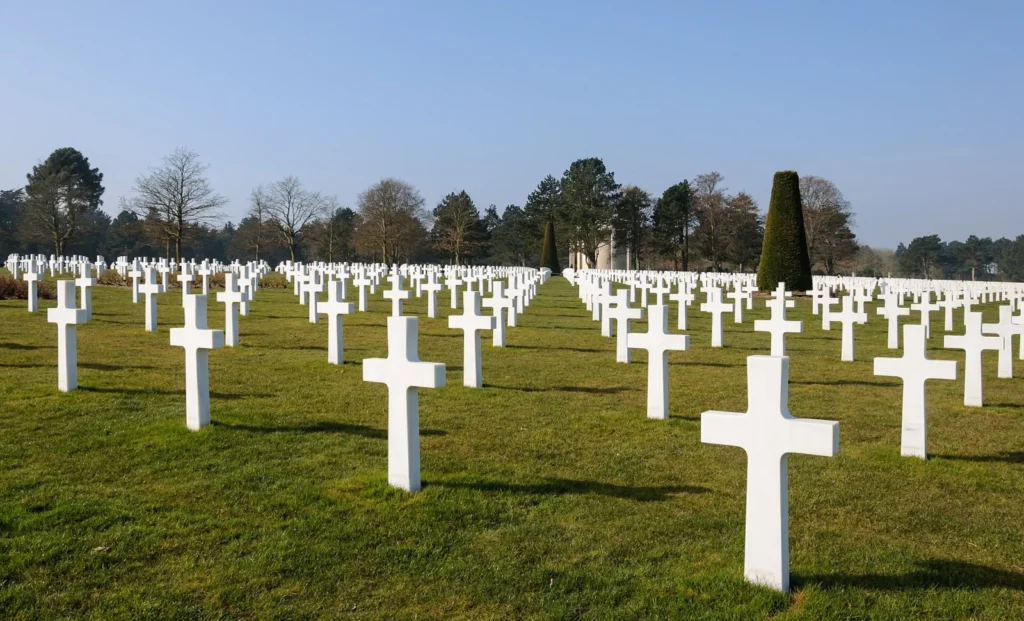
On the bluff above Omaha Beach at Colleville-sur-Mer, 9,388 white marble headstones stand in perfect rows facing the sea. The visitor centre tells individual stories of the soldiers, and a flag-lowering ceremony takes place every afternoon before closing. Entry is free. Allow at least an hour, and go early or late in the day to avoid the coach groups.
Pointe du Hoc
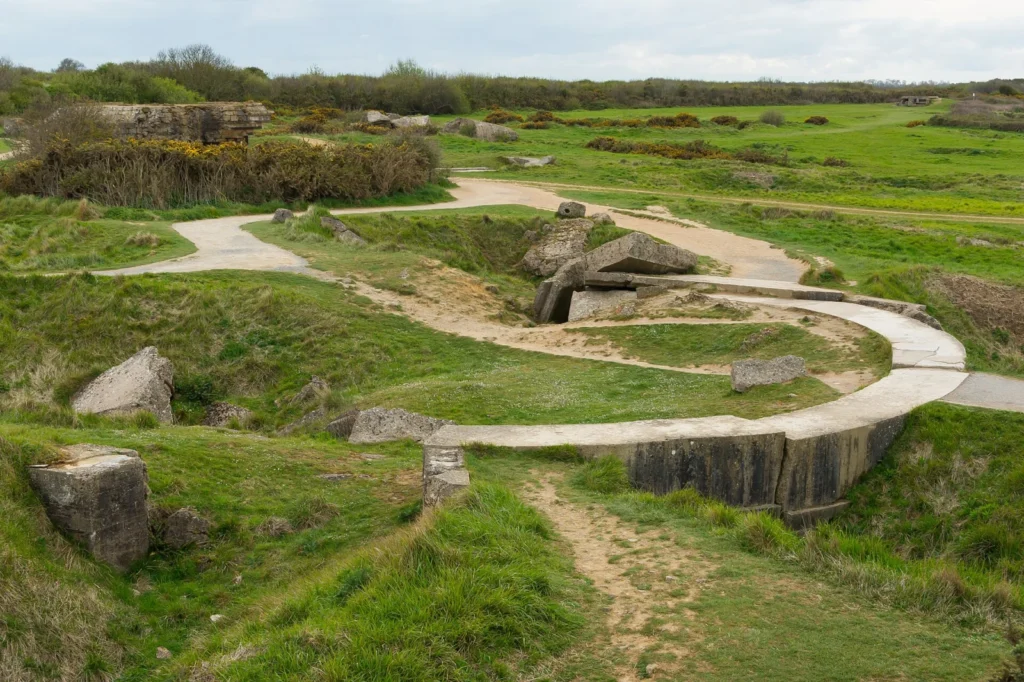
US Army Rangers climbed these 30-metre cliffs under fire to reach a German gun battery, only to find the guns had been moved inland. The clifftop is still pitted with bomb craters and shattered bunkers, and it gives you the clearest sense of the violence of the day.
Omaha Beach

Walk down to the sand at Saint-Laurent-sur-Mer, where the Les Braves sculpture stands on the beach, and look back at the bluffs the soldiers had to cross. The nearby Overlord Museum has one of the best collections of vehicles and equipment in Normandy.
Arromanches and the Mulberry harbour
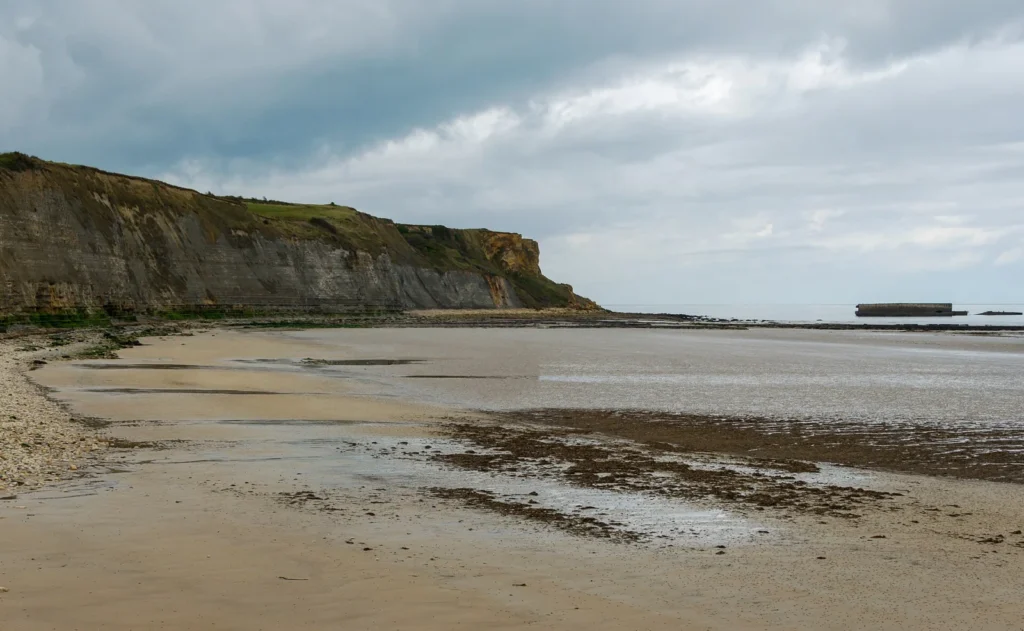
The Allies built an entire artificial harbour here to land supplies after D-Day, and huge concrete caissons are still visible offshore. Watch the circular film at Arromanches 360 on the clifftop, then visit the D-Day museum on the seafront.
The Mémorial de Caen, Juno Beach and Pegasus Bridge
The Mémorial de Caen is the most complete museum on the Second World War and the Battle of Normandy, and a good first stop (allow 2 to 3 hours). Canadian visitors should not miss the Juno Beach Centre, and Pegasus Bridge, with its museum, tells the story of the first British airborne operation of D-Day.
Planning your visit? Hotels in Bayeux fill up early for summer and the week of 6 June. Compare hotels and flights to Paris for your dates.
How to visit the D-Day beaches from Paris
Option 1: a full-day tour from Paris
Coach and minivan tours leave Paris early in the morning and return late at night, usually covering Omaha Beach, the American Cemetery, Pointe du Hoc and Arromanches. It is the easiest option if you only have one day and don't want to plan anything, but expect a 12 to 14-hour day with around 6 hours on the road.
Best for: travellers with only one day and no car Compare reviews and prices for a D-Day beaches day tour from Paris.
Option 2: train to Bayeux and a local tour (our pick)
Take an early train from Paris Saint-Lazare to Bayeux (about 2h15 to 2h30, sometimes with a change in Caen) and join a small-group tour with a local guide, most of which start in Bayeux. You spend far more time at the sites and less on the motorway, and the guides are often excellent. Better still, stay a night in Bayeux and take a second tour of the British and Canadian beaches the next day.
Best for: most visitors, and anyone who wants real depth
Option 3: drive yourself
Rent a car in Caen or Bayeux rather than driving out of Paris. The roads are easy, the sites are well signposted and all have car parks. Bayeux is about 20 minutes from the American Cemetery, and Caen about 45 minutes from Omaha Beach. You'll have total freedom, but no guide to bring the stories to life, so read up or download an audio guide first.
Best for: independent travellers, families and history buffs
Which option should you choose? One day only: a full-day tour from Paris. Two days or more: the train to Bayeux and a local tour. Travelling as a family or group of four: a hire car often works out cheapest.
How much time do you need at the D-Day beaches?
One day: the American sector (Omaha Beach, the American Cemetery and Pointe du Hoc) plus Arromanches.
Two days: add the Juno Beach Centre, Pegasus Bridge and the Mémorial de Caen, or Utah Beach and Sainte-Mère-Église.
Three days: see all five beaches at an unhurried pace, with time for Bayeux itself.
Sample D-Day beaches itineraries
One day: the American sector
- 9:00: Pointe du Hoc, before the coaches arrive.
- 10:15: Omaha Beach at Saint-Laurent-sur-Mer and the Les Braves memorial, then the Overlord Museum.
- 12:00: lunch in Colleville-sur-Mer or Port-en-Bessin.
- 13:30: the Normandy American Cemetery and its visitor centre.
- 15:30: the German battery at Longues-sur-Mer.
- 16:30: Arromanches 360 and the Mulberry harbour, then back to Bayeux for dinner.
Day two: the British and Canadian beaches
- Morning: the Mémorial de Caen (allow 2 to 3 hours).
- Lunch: Bénouville, then Pegasus Bridge and the Memorial Pegasus museum.
- Afternoon: Sword Beach at Ouistreham, then the Juno Beach Centre at Courseulles-sur-Mer.
Tips for visiting the Normandy landing beaches
- Book early for June: the anniversary on 6 June brings commemorations, veterans' events, road closures and full hotels.
- Dress for the wind: the coast is exposed, so bring a windproof jacket and walking shoes, even in summer.
- Check opening times in winter: some museums close for a few weeks in January.
- Respect the cemeteries: keep your voice down and dress respectfully. They are working war graves, not just sights.
- Think about children: the sites work well for children from about 10, especially the museums with vehicles and films.
Where to stay for the D-Day beaches
Bayeux is the best base: a lovely medieval town on the train line from Paris, 15 to 20 minutes from Omaha Beach, with plenty of hotels, restaurants and tour pick-ups. Stay in Arromanches for sea views, or Caen for a bigger city with more trains. Compare prices on our hotel search, and book early for June to August.
D-Day beaches: FAQ
Can you visit the D-Day beaches in a day from Paris?
Yes. A full-day tour from Paris, or an early train to Bayeux with a local half-day tour, lets you see Omaha Beach, the American Cemetery and Pointe du Hoc in one day. It is a long day, so stay a night in Bayeux if you can.
Which D-Day beach is most worth visiting?
Omaha Beach, together with the American Cemetery and Pointe du Hoc, is the most powerful visit for most people. British and Canadian visitors often prefer Gold, Juno and Sword, with Arromanches, the Juno Beach Centre and Pegasus Bridge.
How far are the D-Day beaches from Paris?
About 270 kilometres. That is roughly 3 hours by car, or 2h15 to 2h30 by train to Bayeux followed by a 20-minute drive to the coast.
Can I see the Bayeux Tapestry when I visit?
Not until mid-2027. The tapestry is on loan to the British Museum in London from 10 September 2026 to 11 July 2027, and its museum in Bayeux is closed for renovation. Check the official Bayeux website before you plan around it.
Where are the Normandy beaches?
On the coast of Normandy in northern France, along the English Channel between the Cotentin peninsula and Caen, about 270 kilometres west of Paris. The nearest towns are Bayeux, Arromanches, Courseulles-sur-Mer and Ouistreham.
Are the D-Day beaches open to the public?
Yes. All five beaches are public and free to visit at any time, and in summer people swim and sunbathe there. The Normandy American Cemetery is free and open every day from 9:00 to 17:00, except 25 December and 1 January. Museums charge entry and have their own opening hours, and some close for a few weeks in winter.
Can you walk on Omaha Beach?
Yes. You can walk on the sand along the whole of Omaha Beach. The easiest access is at Saint-Laurent-sur-Mer, by the Les Braves sculpture, and paths lead up from the beach to the American Cemetery on the bluff above.
Which country lost the most soldiers on D-Day?
The United States. Of the roughly 4,400 Allied soldiers killed on 6 June 1944, about 2,500 were American, many of them at Omaha Beach. Britain and Canada also suffered heavy losses on Gold, Juno and Sword.
Ready to visit the D-Day beaches?
Book your train or car, a hotel in Bayeux and a local tour early, especially for summer and the first week of June.
Seeing more of the region? Add a visit to Mont-Saint-Michel, about 1h30 from Bayeux, or read our Normandy travel guide, or plan your days in the capital with our 5 days in Paris itinerary.
Photos from Wikimedia Commons: Normandy American Cemetery by Myrabella (CC BY-SA 3.0); Pointe du Hoc, Omaha Beach and Arromanches by Jebulon (CC0).